

 Focus on the experience
Are summer pre-college programs worth it? Pros and cons for high schoolers
Posted by
Summer vacation. This phrase conjures up images of sleeping late, hanging with friends, maybe a beach trip, or more hours at your part-time job. For most high schoolers, it’s a welcome (and much-needed) break from the non-stop routine. But what if you could still get that well-deserved break and get a serious head start on your college journey? Ever think about a pre-college program?
Taking a break from the high school grind doesn’t require hitting pause on your education, especially if you’ve got goals for your future. Pre-college programs are one of the best-kept secrets for anyone hoping to level up their academic game, explore new interests, and get a sneak preview of college life.
Pre-college programs weren’t around as much in your parents’ day — not like they are now, anyway. Today’s pre-college courses offer amazing opportunities to really dig deep and get granular, learning about topics you’re passionate about, or even subjects you never knew you’d love, while meeting new people and gaining invaluable experience.
Maybe you want to figure out your post-high school plans or try a major on for size. A summer intensive gives you that opportunity. You might find, as one of my high school son’s friends did after taking a pre-college architecture class, that he didn’t want a career as an architect after all. Or you might discover, as another of his friends figured out after participating in a pre-college animal science program, that yes, indeed — he absolutely does want to become a veterinarian.
The cool thing about these programs? They can build your confidence, boost your maturity, help you fine-tune your approach to studying and time management, and strengthen your academic foundation.
But let’s address the elephant in the room. These pre-college programs usually have a hefty price tag, often costing thousands of dollars. So, if you want to enroll in one to get ahead, confirm what you think you want to major in, or just get a taste of the academic pressures most college students experience, it’s fair to ask the big question: Is a pre-college course worth the money and time, especially if you hope to earn actual college credit?
What exactly are pre-college programs?
 Ok. Before we get into the nitty-gritty of credit versus no-credit, know that not all summer programs are created equal. The term “pre-college” refers to academic programs designed to mimic the college experience. What these programs aren’t? Summer camps with a book.
Here’s how they work:
In-person and virtual formats
In-person programs are the most traditional, where you attend classes on a host college or university campus. You may be able to commute or choose a residential option. Commuters attend classes on campus during the day but head home at night. It’s a great option if you live close to the sponsoring school and want to save a little on room and board. The residential option gives you the full college experience. You live in a dorm, eat at the dining hall, and attend classes and activities on campus. It’s a great way to practice independence and get a feel for the day-to-day rhythms of college life.
Virtual programs offer flexibility by allowing you to learn from the comfort of your home (or wherever you are). They typically have two flavors: synchronous and asynchronous. In synchronous programs, everyone logs on at the same time for live lectures, discussions, and class participation. It’s the closest thing to a real classroom environment online. Asynchronous programs are even more flexible. You watch pre-recorded sessions and complete coursework on your own schedule, which is perfect if you have other summer commitments like a job or family travel.
The academic core
Expect a demanding, college-level workload. You typically take one or two core classes, and many programs also layer on additional workshops, seminars, and enrichment activities. Some pre-college programs are called “Summer Intensives” and have a heavier course load, meaning you may take three or more classes over the program’s duration. In other words, be prepared to work hard!
Topic choices
Honestly, no topic is off-limits. Interested in robotics? Want to write novels? Curious about biochemistry? Hoping to work at an embassy? There’s a program out there for you. Here’s a small sampling of your options:
- STEM & computer science: Robotics, AI, coding, advanced physics
- Business & entrepreneurship: Startup strategies, finance, marketing
- Healthcare & nursing: Medical ethics, anatomy, pre-med shadowing
- Art & design: Digital media, studio art, fashion design
- Humanities & social sciences: History, world languages, philosophy
- Performing arts: Theater, music, dance
Program length
Most pre-college programs run for 1 to 8 weeks. Duration typically depends on how much material the program must cover and whether or not it awards college credit. Longer programs often award credit.
An important caveat
Pre-college programs aren’t a golden ticket. Attending one of these programs at a specific college or university doesn’t guarantee automatic acceptance if you apply there as a high school senior. However, your participation does:
- Highlight your initiative
- Show admissions officers you’re serious about your future
- Adds depth to your college applications
- Shows you can handle college-level academic rigor
Credit vs. non-credit pre-college programs
Perhaps you’re already juggling a few accelerated classes now, like honors, AP, or dual enrollment. Pre-college courses fit into that same category. But when you compare different summer programs, you have to decide whether to pursue college credit, too. A program that awards college credit isn’t automatically superior to a non-credit experience.
Base your decision on your own goals. Are you trying to get an academic edge and explore a subject or get a head start on earning transferable credits? Let’s look at the pros and cons, as both choices have trade-offs.
The upside (pros)
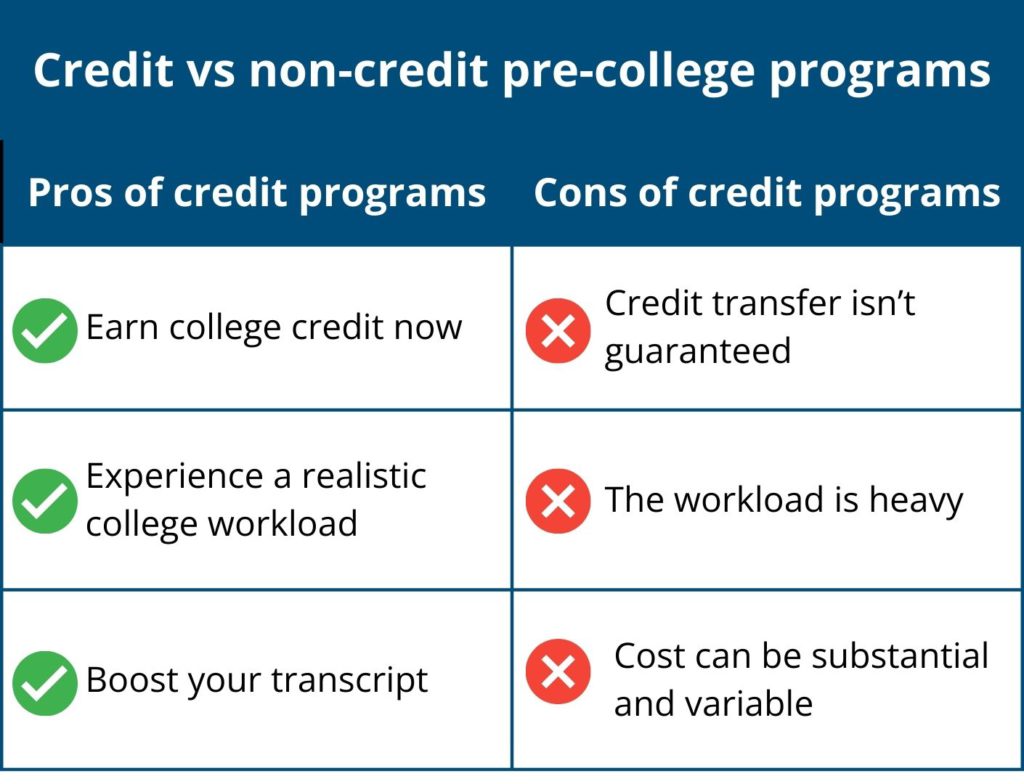
- Earn college credit now. This is the big pro. Successfully completing a for-credit course means you get college credits before starting college. Like AP credits, these could potentially let you skip an introductory course or two as a college student, saving you time, opening your schedule for more electives, and potentially saving you (and your parents) some money.
- Experience a realistic college workload. There’s no sugarcoating it. These classes are fast and intense. You’ll get a real, authentic taste of college classes — fast-paced lectures, more independent study, and bigger projects with firm deadlines. This trial run will help you understand exactly what to expect your freshman year.
- Boost your transcript. When admissions officers see an “A” in a college-level course, especially one where you earned college credit, it sends a strong signal. That grade tells them that you can handle challenging, demanding coursework and can help your academic record stand out in a competitive applicant pool.
The downside (cons)
- Credit transfer isn’t guaranteed. The credit you earn is guaranteed only by the school that offers it. Each college and university has its own unique (and admittedly, sometimes frustrating) rules about credit transfer. If you attend an Ivy League pre-college program but opt to go to your state university, those credits might not count. Check the transfer policies of your top-choice schools.
- The workload is heavy. Pre-college programs and summer intensives compress college-level material into a few short weeks. Assignments are longer. The pace is rapid. Expectations are high. Expect to spend many hours outside of class studying and working on assignments, which may reduce your typical summer leisure time.
- Cost can be substantial and variable. Most of the time, you’ll pay more for a credit-awarding course than its non-credit counterpart. In-person residential programs also cost more than commuter or online programs because you’re paying for room, board, and campus amenities. If your future college doesn’t accept the credits, you’re investing in the experience and transcript boost rather than tuition savings.
Why non-credit programs still rock
The benefits of attending a pre-college program extend beyond getting a few college credits, so don’t knock those non-credit options. These programs help you grow and prepare for the future in ways a grade on a transcript can’t capture.
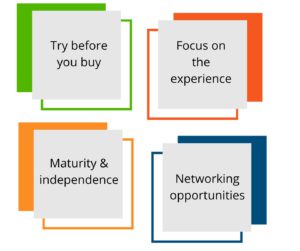
Try before you buy
A non-credit pre-college program is the perfect, low-stakes way to explore a major or field of study. Thinking about becoming an attorney? Take an introductory, non-credit course in law to see if the reality matches your expectations. If you hate it, you saved yourself four years of undergrad plus law school classes (and a ton of debt).
 Focus on the experience
With less pressure from final grades determining credit, you can focus on learning, asking questions, networking with professors and peers, and thoroughly enjoying the experience. You may even learn more when the pressure is off.
Maturity and independence
Living away from home (if you opt for a residential pre-college program) for a few weeks is a huge step. You’re learning how to manage your time, do your own laundry, budget your money, and navigate a new city or campus — skills absolutely essential for college success.
Networking opportunities
You’ll meet other like-minded, ambitious students who may come from all over the world and all walks of life. These connections can become lifelong friendships or professional contacts. Plus, you get face time with college professors and teaching assistants (TAs). Building a solid rapport with a professor can lead to a great letter of recommendation later, which is worth its weight in gold.
As you weigh your options, choose a pre-college program aligned with your educational path. Don’t chase the credit if the experience itself is your priority (and that’s totally fine!).
Making the most of a virtual experience
Online pre-college programs — whether for-credit or not — give you tons of freedom. Learning from home is a great benefit if you’ve got a summer job, sports or other commitments, or need to help care for younger siblings.
But tackling difficult, college-level courses online requires a little extra mental muscle and attention to stay engaged, especially when the beach, pool, or video games are calling your name. It’s easy to get distracted when your bedroom is your classroom. Try these tips to help you stay focused and maximize your ROI for an online summer course.
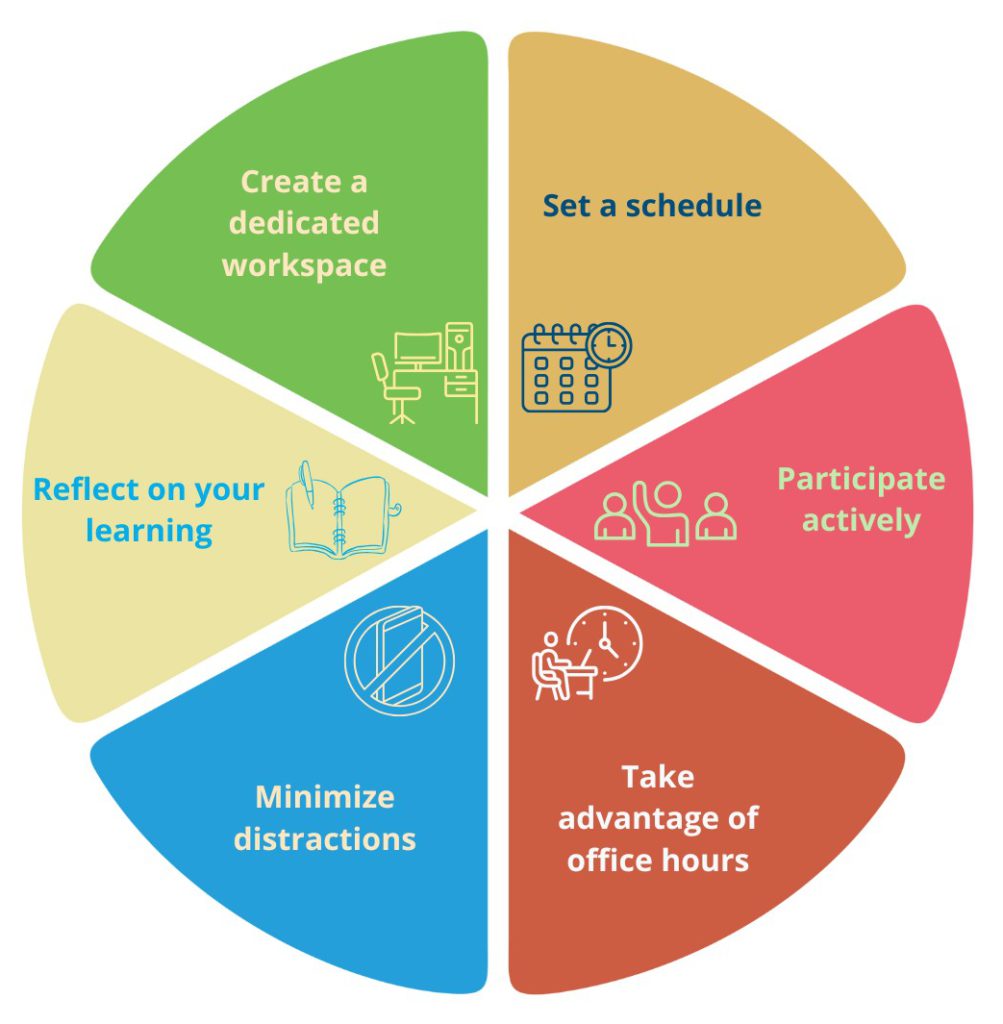
1. Create a dedicated workspace
Don’t just flop on the couch (or your bed) with your laptop. You need a space that your brain recognizes as “work mode.” Set up a quiet, comfortable spot, like a desk in your room or the corner of the dining room table, and keep it organized. Your sanctuary should be free from the distractions of the rest of the house. Tell your family that when you’re in this spot, you’re “at class.”
2. Set a schedule
You might be attending class from home, but treat it as you would an in-person class.
- Log in on time (if it’s synchronous). Punctuality matters.
- Plan dedicated study sessions and homework time that fit your schedule. Treat this time as you would a sports practice, rehearsal, or job shift.
- Set reminders for each assignment and deadline.
3. Participate actively
It’s easy to hide behind a muted mic or turned-off camera. Resist the temptation to ghost your professor and classmates. Active participation enhances your learning, especially online. Ask thoughtful questions, join discussion forums, and engage with classmates during breakout sessions. When you make an effort to connect, you learn more, stay connected to the material, and the class feels much less isolating.
4. Take advantage of office hours
Every college professor or teaching assistant (TA) holds office hours: dedicated times for students to drop in virtually. Use them! Reach out for extra help, clarification on a complex topic, or guidance on a project. Building strong connections with the program’s faculty and TAs now can help you later, especially if you need a personalized letter of recommendation for your college applications.
5. Minimize distractions
Your phone is your nemesis during class time. Silence it. Put it in a drawer or another room. Close all unrelated tabs and social media windows on your computer. When you’re attending a virtual lecture or working on a project or paper, commit to focusing fully for a set block of time (and set a timer if it helps). The mental energy saved by avoiding context-switching? Huge!
6. Reflect on your learning
At the end of each week, take 15 minutes to journal or think about what clicked and what tripped you up. Tracking your progress increases the value of your study sessions. Even more importantly, reflecting on what you enjoyed most (or least) about the class can give you gigantic insight into your future. Did you love the lab portion of your biology class? Maybe a research career is a good fit. Did you despise the essay-writing component but love the group presentations? Perhaps a career in communications or public speaking is a better fit than journalism. These programs are as much about self-discovery as they are about academics.
A worthwhile investment in you
The ultimate goal of a pre-college program, whether you walk away with credit or not, is the same: to grow. You’ll emerge more confident, more mature, more independent, and with a stronger academic foundation that will serve you well as you complete high school, earn a college degree, and beyond.
Enrolling in a pre-college program is a big decision, especially for whoever is footing the bill. But if you approach accelerated academics with a mindset of hard work, curiosity, and commitment, a pre-college summer intensive might be positively transformative.
For inspiration and lots of pre-college programs, check out our latest Summer Programs guide.

Blog Categories
- Career Advice
- College Admissions
- Colleges & Universities
- Financial Aid and Scholarships
- For Counselors
- For Parents
- For Students
- Gap Years
- Mental Health and Wellness
- Online Learning
- Performing and Visual Arts
- STEM Majors and More
- Summer Programs
- Teen Volunteering
- Trade & Vocational Schools
- Tutoring & Test Prep







Organization with listings on TeenLife? Login here
Register for Free
We’re here to help you find your best-fit teen-centered academic and enrichment opportunities.
Forgot Password
"*" indicates required fields