


Why you should consider a summer program on AI
Posted by
Summertime means break time, right? A break from tests and lectures, time at the lake, or traveling someplace new. But what if you love technology (especially video games) and you’re leaning toward doing something after high school in the tech field? Chances are you’ve heard of Marques Brownlee (MKBHD) or Austin Evans, Aphmau, or Mark Rober, right? And you probably know a little about AI, machine learning, or data science, even if you haven’t studied those topics at school.
Curious to learn more? Why not check out a summer program focused on AI? Learning about artificial intelligence can help you future-proof your life and grow your understanding of the world you already live in. From the TikTok algorithm that knows exactly which video to show you next to Netflix’s recommendation engine, AI is everywhere. It’s a foundational skill for the 21st century, much like reading and writing were in the last century. And your summer break is the perfect, low-pressure time to explore it.
Deconstructed: What are these buzzwords, anyway?
Before you commit to a camp, let’s break down the jargon.
Artificial intelligence (AI)
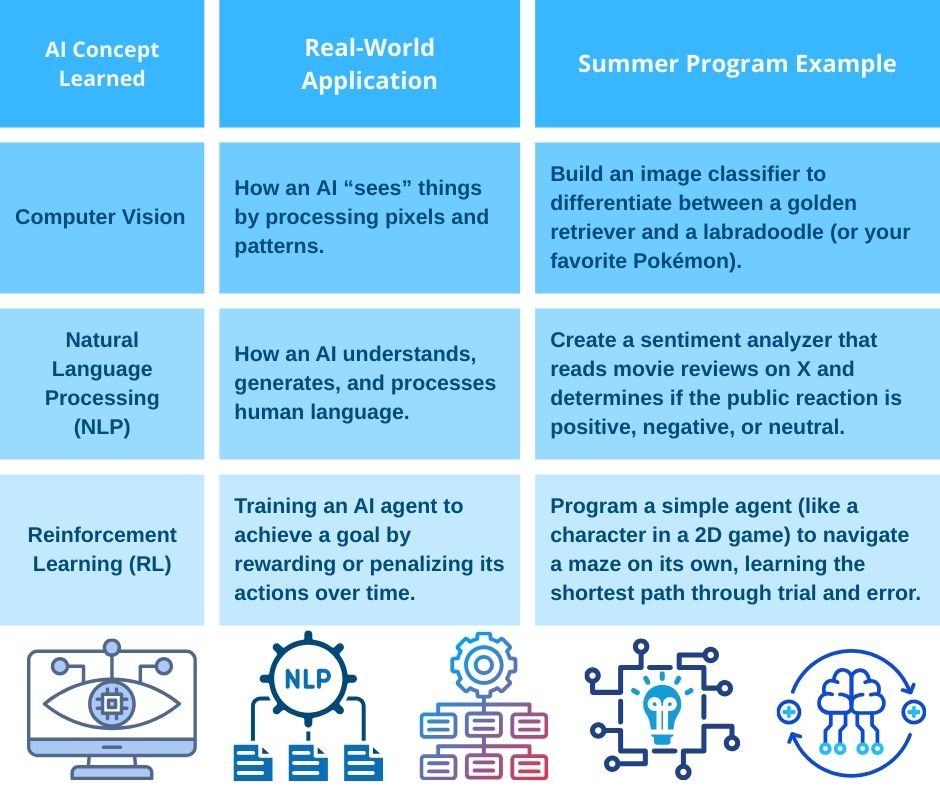
Think of it as the “big goal.” It’s the science of making machines that can mimic human intelligence through learning, reasoning, and problem-solving. Siri, Alexa, those self-driving cars in movies, ChatGPT, and Snapchat algorithms rely heavily on AI. It’s the umbrella over everything. When you see an AI character in a video game that appears to react realistically to your moves? That’s AI in action.
Machine learning (ML)
This technology teaches computers to learn without being explicitly instructed on every single step. An ML program feeds the computer a huge amount of data (thousands of pictures, millions of songs, all search results from one year). Then the computer’s algorithm crunches the data to identify specific patterns and rules. Instead of using human-written rules, the computer generates its own mathematical rules from the data. Finally, the computer uses the patterns it has learned to make a prediction or decision.
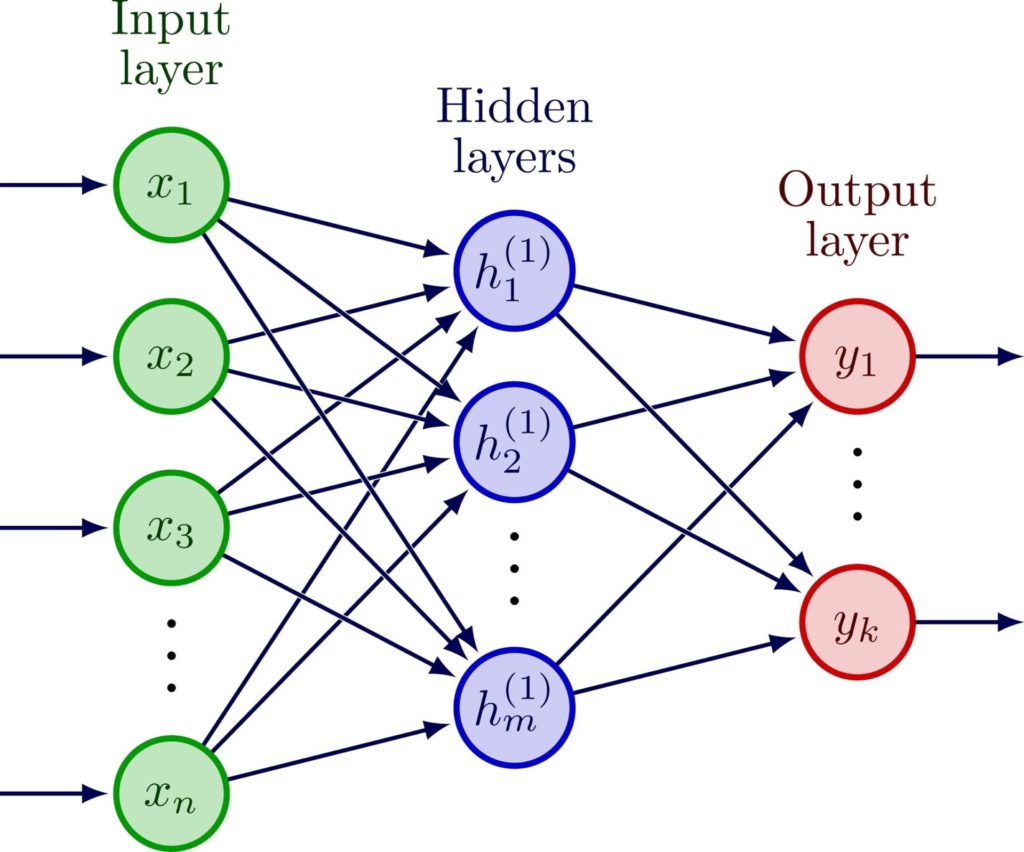
ML’s magic is often called a neural network, but don’t let the name intimidate you. It’s a bunch of interconnected math formulas loosely modeled after the human brain. You input data (like a photo of a cat), it passes through layers of “neurons” (the math nodes), and finally, the program spits out an answer (“Yes, that’s a cat!”). The more data ML processes, the better and smarter those connections become.
Check out the diagram below. Data enters the input layer, travels through the hidden layers, where complex calculations (the “learning”) happen via connections and weights, and then exits through the output layer with a decision or prediction. You get to build and train those networks.
Data science (DS)
DS uses math, coding, and computers to solve problems and uncover hidden secrets and patterns in piles of information or data. A data scientist identifies the main issue they want to solve, gathers information to answer the question, cleans the data, and uses ML to find patterns in the cleaned data.
Data science is the disciplined process of turning a massive, messy pile of information into a clean, actionable insight. This insight bridges raw data and a working AI model.
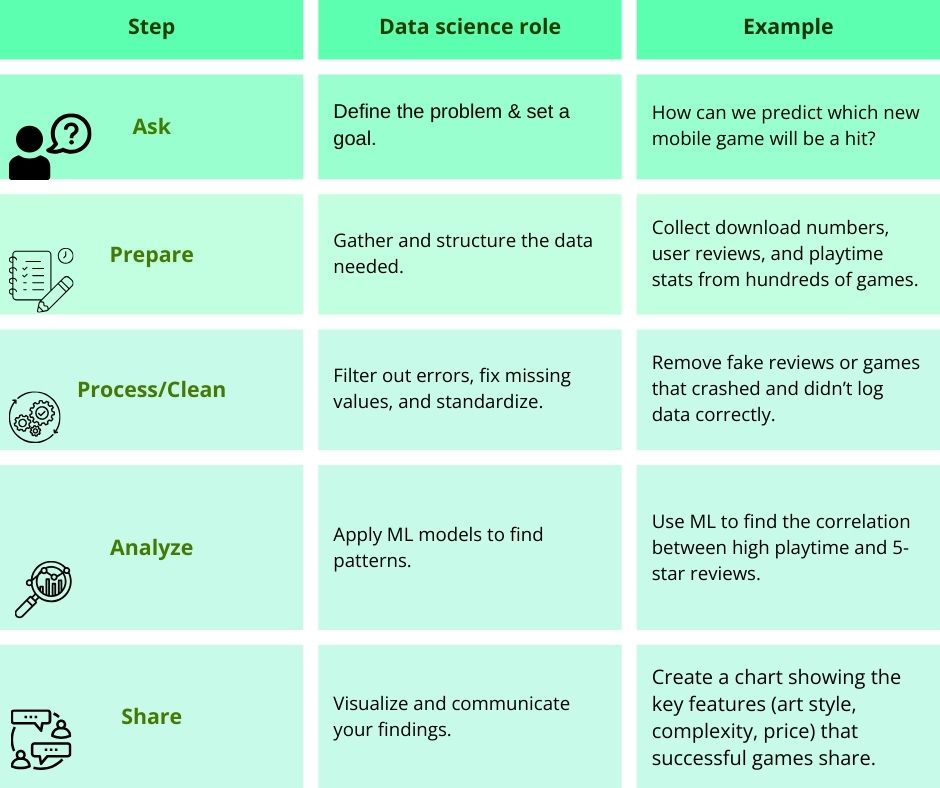
A good summer program connects the dots even as you learn coding. You’ll use data science to gather information, train an ML model, and create a cool piece of AI. So while you use the technology, you’ll learn the mechanics of how it’s built.
Why AI is an essential skill
You often hear that AI is changing the job market. That’s true — but let’s flip the script. Instead of viewing AI as something that’s going to take jobs, think of it as a tool that will supercharge existing careers and make possible careers that don’t even exist yet. Learning AI now is like learning to use a calculator while everyone else is still counting on their fingers (and toes).
Critical thinking for the digital age
While learning AI requires learning to code, along the way, you also improve your problem-solving and logical thinking skills. Every AI project starts with a problem: How can we predict the weather better? How can we tell if this piece of writing is an original essay or generated by a chatbot?
In an AI-focused summer program, you’ll learn to break down complex problems into smaller, manageable steps — a skill that comes in handy for math, history, figuring out college application strategies, and more. Instructors will encourage you to think critically about the technology itself and ask the deeper questions that separate a smart user from a responsible creator.
 The ethics of AI: Fairness and bias
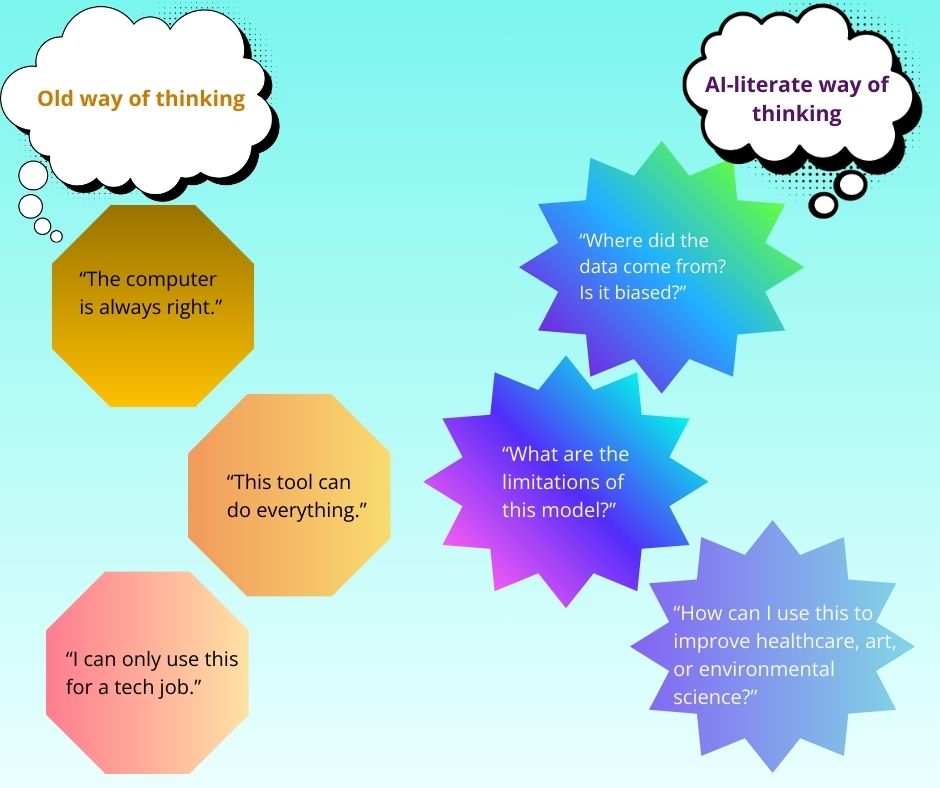
The American Psychological Association (APA) and other major organizations believe that AI literacy is a crucial life skill for adolescents today. It’s important to scrutinize the source, as AI-generated content can often appear authoritative, even when it’s entirely incorrect or biased.
Here’s the thing. AI is only as good as the data you feed it. If a team feeds an image recognition AI a dataset primarily containing photos of light-skinned people, the AI will struggle to identify and process dark-skinned faces correctly. This challenge is called algorithmic bias. The machine isn’t racist per se, but it is reflecting the flaws and inequalities of the real-world data on which it was trained.
A strong summer program will dedicate time to discussing the ethics of AI. As you learn how to build and work with this technology, you’ll also learn how to audit it, test its fairness, and understand the real-world consequences of unleashing a biased model to make decisions about people’s lives (like who gets a loan or job interview).
A career boost, regardless of major
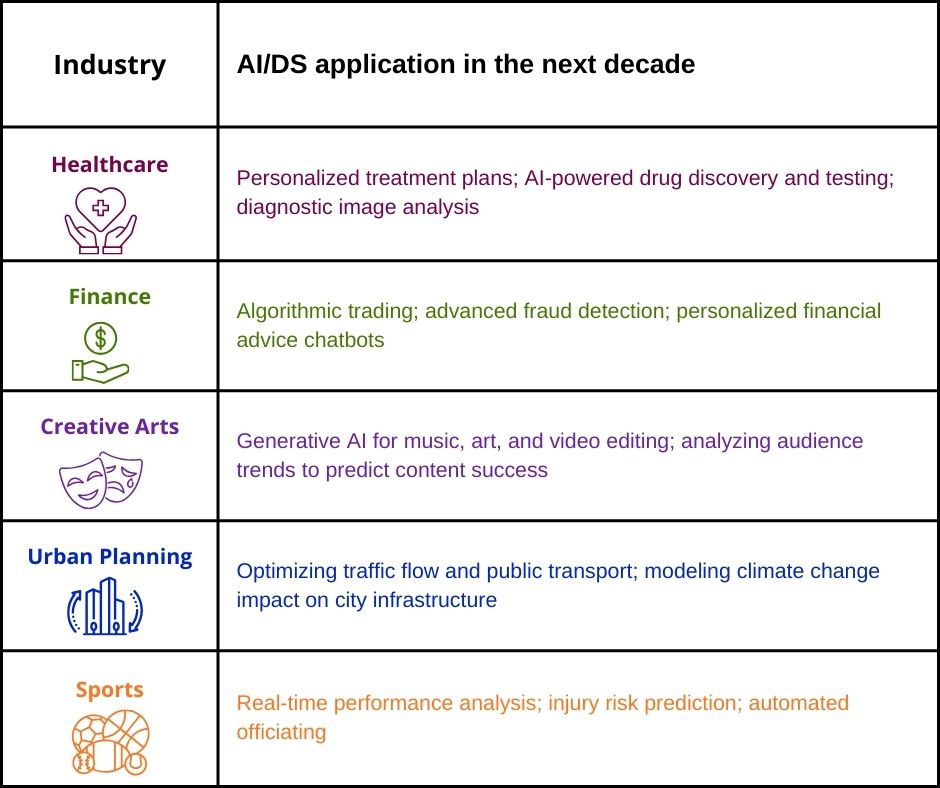
Learning more about AI is a game-changer for college applications and your future resume. College admissions officers and future employers aren’t just looking for students who know about AI; they want students who know how to apply it to solve problems in any field.
Consider these hypothetical scenarios:
- Aspiring environmental scientist? You attended an AI summer program where you built an AI model to predict flash floods on satellite data and local weather patterns. You can talk about using technology to protect ecosystems.
- Interested in music production or art? You took a summer program where you learned how to use ML to analyze the musical features of different songs (rhythm, harmony, key) and use that data to compose new melodies in the style of your favorite artist or generate custom video game soundtracks.
- Dreaming of medicine? You participated in a project where you trained a computer vision model to help doctors analyze X-rays faster, highlighting potential areas of concern that the human eye might miss.
The takeaway? Every field, from medicine and law to fashion and farming, will be seeking people who can perform their job and leverage AI to do it better. Gaining a foundational understanding of AI and data science now gives you a massive head start, regardless of your eventual career path. Taking a technology-focused summer program shows college admissions officers and future employers that you’re already thinking about your future and you’re ready to become a creator, not just a consumer.
Summer tech programs FTW!
While you could watch YouTube tutorials on Python (AI’s primary coding language), a dedicated summer program offers things an online video can’t: structure, dedicated mentorship, and a collaborative environment.
Why Python is your new best friend
You don’t have to be a coding whiz to start. Most programs will teach you Python from the very first line of code. But why Python?
- Readability. It’s easy to read, making it a great first language.
- Community. It has a massive community and thousands of free libraries and tools that make AI work possible (like NumPy for number crunching and Pandas for data management).
- Industry standard. It’s the language of choice used by Google, Netflix, and NASA (among other companies) for building AI systems.
Learning Python in a structured course prevents you from getting stuck in “tutorial hell,” where you jump from video to video without ever building (let alone completing) a cohesive project.
Collaboration and mentorship
AI, ML, and data science summer programs are typically project-based. You’ll work on a team with other students and be led by grad students or working professionals from top universities and companies.
- Real-world projects: You’ll engage with real-world projects, learning how to use ML and AI to solve challenges like improving a hospital’s patient scheduling processes or building a computer vision model to identify different bird species. This hands-on experience is priceless for your portfolio.
- Mentors: Your instructors are teachers, but they are also people currently working in the field. They can tell you what it’s like to work at a tech company or pursue a PhD in ML. Their guidance can save you years of figuring things out on your own.
- Your future network: You’ll meet people who share your intellectual curiosity, forming a network of future engineers, artists, and entrepreneurs. The person you code with this summer might become your co-founder in a few years, or maybe a lifelong friend who shares your obsession with all things tech.
Make learning fun
Let’s face it: learning something new and complex is way more fun when it’s gamified and interactive. Summer programs specialize in this approach, turning concepts that seem dry in a textbook (think statistical modeling or neural networks) into engaging projects.
The focus shifts to application and creation, not just theory — a strategy that helps concepts stick and turns a complex subject into something you’ll enjoy and maybe want to explore further.
What to look for: A quick checklist
When comparing summer programs, keep this rubric in mind. Finding the right fit is crucial for maximizing your summer learning.
The curriculum vitals
- Project-based learning: Is the program’s core building a tangible project you can include in your portfolio? Avoid lecture-heavy programs. You want to make something.
- Beginner-friendly tracks: Does the program explicitly state that you don’t need prior coding experience? A good program teaches the tools (like Python and its libraries) from the ground up, ensuring everyone starts on the same footing. If you already have some experience, look for an advanced track that takes you beyond the basics.
- A focus on ethics: Does the program discuss the importance of AI ethics and bias? This topic is an essential element of the program and shows that it recognizes the importance of creating responsible innovators (not just coders).
The logistics (in-person or online)
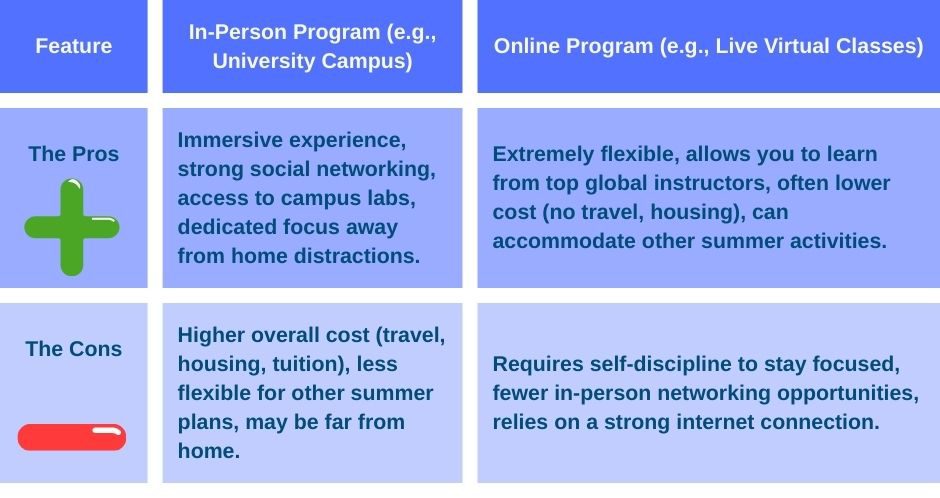
The format matters! Decide what works best for your schedule and learning style.
Mentorship and instructors
Who’s teaching the class? Look for programs led by university students/professors (Harvard, Stanford, MIT) or industry professionals. The quality of your instructor directly impacts the quality of your experience.
The fewer students per mentor, the more personalized attention you’ll get when you hit a frustrating bug in your code (and you will hit bugs — it’s part of the process). A low student-to-mentor ratio, like 10:1 or better, is a great sign.
Duration and cost
Programs range from intensive, one-week bootcamps to more relaxed, six-week courses. Shorter courses are great for a quick introduction; longer ones allow you to really get into the nitty-gritty details and complete a substantial, portfolio-worthy project.
AI programs can get pretty expensive, but don’t let the cost stop you. Look for programs that offer financial aid, need-based scholarships, or specific diversity grants. Many top universities and educational organizations reserve spots for students who can demonstrate financial need. Do your research and apply where it makes sense.
Post-program planning to keep the momentum
The summer will end, but your learning doesn’t have to pause. A great program sets you up for what’s next.
- The portfolio project: The program should encourage you to host your final project on GitHub, the social network for coders. Colleges and employers can visit this platform to see your skills and ideas. Ask your mentor to help you clean it up and document it well.
- MOOCs and next steps: Ask your instructors for recommendations on MOOCs (Massive Open Online Courses) on platforms like Coursera or edX. They can guide you to the next level course (like Deep Learning with PyTorch) that builds on your summer foundation.
- Local hackathons: Look for local or online hackathons in the fall. These are fast-paced, competitive events where you can use your new AI skills to build something amazing in 24-48 hours — an incredible resume builder and a ton of fun!
Final takeaway
Exploring AI, ML, and data science in a dedicated summer program is a great way to transform your love of video games or social media into a valuable, future-proof skillset. Your summer break should absolutely include time for recharging, but don’t pass up an opportunity to level up your own knowledge and intelligence by understanding the systems running the modern world.
Learning to code and build AI adds a line to your college application or high school resume, but also a way for you to gain power:
- The power to understand how your TikTok feed works.
- The power to detect bias in algorithms.
- The power to develop solutions for the world’s biggest problems, like climate change or hunger.
When you return to school, you won’t be using technology; you’ll be an AI-literate citizen. You’ll understand the ethical debates surrounding deepfakes, job automation, and privacy. This knowledge will help you stand out in every class, from history to economics.
Growth doesn’t have to mean sitting in a stuffy classroom. Instead, try stepping up to become one of the next generation of innovators. Take that leap this summer. It can mean the difference between being a tech consumer and a creator of the future. Go, build something awesome!
And for more inspiration, check out our latest Summer Programs Guide.

Blog Categories
- Career Advice
- College Admissions
- Colleges & Universities
- Financial Aid and Scholarships
- For Counselors
- For Parents
- For Students
- Gap Years
- Mental Health and Wellness
- Online Learning
- Performing and Visual Arts
- STEM Majors and More
- Summer Programs
- Teen Volunteering
- Trade & Vocational Schools
- Tutoring & Test Prep



Organization with listings on TeenLife? Login here
Register for Free
We’re here to help you find your best-fit teen-centered academic and enrichment opportunities.
Forgot Password
"*" indicates required fields