


From summer high to gap year reality: Is that amazing program enough to decide your future?
Posted by
Picture this: It’s the final week of August. You’re unpacking your suitcase, but you’re not the same person who zipped it up three months ago. Maybe you just spent five weeks in Costa Rica nailing down your Spanish and volunteering at a wildlife rescue. Perhaps you aced a challenging coding boot camp that showed you how much you love building things. Or maybe you ventured deep into the wilderness on an outdoor leadership trek, learning to navigate by the stars and trusting your own instincts for the first time.
It was, hands down, the best summer of your life. And now, as the reality of life after high school creeps closer, a question pops into your head, bright and impossible to ignore: What if I don’t go to college… yet?
You’ve gotten a taste of independence, challenge, and purpose. That little sample convinced you that a gap year might be exactly what you need. But hold up. A summer program is like a beautifully curated four-star meal. A full gap year? That’s like signing on to become the head chef, waiter, and dishwasher for 365 days.
Is a phenomenal summer program experience enough to make a year-long decision? The short answer? Nope. It’s an important part of the puzzle — it’s data. But you need to collect way more data before you (and your parents) sign off on a year that will change your whole trajectory. It’s not a quick flip-flop, like swapping honors for AP chemistry.
Let’s explore the reasons why students take gap years, questions you should ask yourself, and how to tell the difference between temporary summer euphoria and genuine, year-long motivation.
Part I: Why you’re thinking about a gap year (and why it’s totally normal)
 Before we get into the practical stuff, let’s normalize the urge. The pressure to go straight from high school to college is intense, but the benefits of hitting the pause button are legit. Teens take gap years for tons of different, valid reasons. Your summer program just gave you a nudge in one of those directions.
Here are five common scenarios — do you see yourself in one (or more) of them?
The burnout: “I just can’t look at another textbook.”
You spent four years grinding: APs, extracurriculars, standardized tests, and not much sleep. You got into college, but the idea of four more years of high-stakes academics makes you want to curl up into a ball. You. Need. A. Break.
- Your gap year goal: Recovery and recharge. Your summer gave you a chance to use your brain differently. A gap year focuses on mental health, finding joy in learning again, and coming to college energized, not exhausted. You’re not avoiding college; you’re preparing to crush it after a year-long detour.
The explorer: “I have no idea what I want to do with my life.”
You’ve narrowed down your college choices, and it’s time to apply. But when you look at the “Majors” dropdown menu, you freeze. Pre-med? Business? Fine arts? You’re staring at a $100,000+ commitment for a path you’re not even sure you’ll like.
- Your gap year goal: Targeted exploration. Your summer might have given you a taste of something you love (say, marine biology). A gap year invites you to take a deeper dive. You could shadow professionals, volunteer, or intern. Enter the potential for career exploration. A gap year allows you to test-drive a career now instead of spending time (and lots of money) changing your major four times during college.
The planner: “I need to save some serious cash.”
College is expensive. Period. Maybe your family’s financial situation changed, or you realized you want to graduate with less debt. You’re the practical type who knows a year of focused work could make a huge difference.
- Your gap year goal: Financial stability. You plan to work a full-time job (or maybe a few part-time gigs) and save every possible dollar. You’re using your time off as an investment in your financial future. Need ideas? Check out creative strategies for funding your gap year for tips on making your money work harder and stretch further.
The skill builder: “I need a specific edge.”
Your dream school or job requires a skill you don’t have — yet. Maybe you need fluency in Japanese, advanced coding certs, or a wilderness EMT certification to get into the competitive outdoor adventure program you want.
- Your gap year goal: Acquisition. You’re treating the year like a dedicated training camp. You structure each month around mastering a tangible skill that will make you a more competitive applicant or more effective human being.
The deferral dilemma: “I got in, but I’m going to defer.”
You applied, got accepted, and you’re excited about the school… but you know you’re not ready to go right now. Maybe you want to travel or work on a personal passion project.
- Your gap year goal: Intentional pause. You’ve secured your spot, and now you’re using the year to gain unique experiences that will enrich, not distract from, your college life. If this path appeals, you need to know how to keep your spot at college safe by deferring your acceptance.
Part II: Self-reflection
Your summer experience gave you your first data point. Now, let’s run a diagnostic check. The difference between a successful gap year and a year spent playing video games in your parents’ basement (or scrolling TikTok) is intentionality.
What do I enjoy most, and why?
This question helps tease apart the fun from the meaningful. Everyone loves a break from responsibility and making new friends, but a gap year needs a deeper purpose than just hanging out.
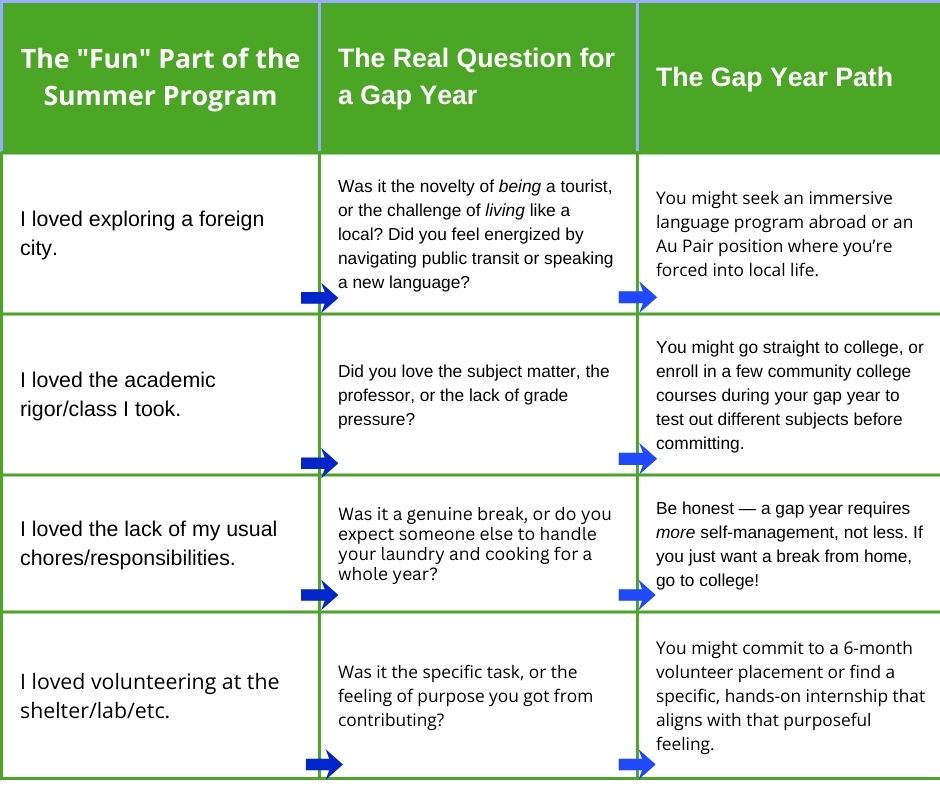
The bottom line? If you mainly enjoyed the social aspect, dorm life, or novelty, college life offers that structured fun with a path forward. If you loved the independence, hands-on work, or deep learning outside of a classroom, a gap year may be calling your name.
Which parts of the program challenged me most, and why?
Even the best experiences have tough moments. A gap year is 12 months of challenge. You need to know what you’re up against.
- Homesickness/loneliness: Your summer program had built-in friends and staff support. A gap year often doesn’t. If being away from your support system was hard for five weeks, can you manage eight months (or longer)? You need a solid plan for staying connected and making new friends; it’s a crucial aspect of resilience.
- Academic rigor: If you struggled with the coursework, a gap year working a job might be the perfect palate cleanser. But if you’re taking a gap year to travel, you need the discipline to stick to a budget, solve passport and visa issues, and manage logistics, which is a different kind of rigor.
- Conflict/disagreement: Did you struggle when you had to share a room or navigate a conflict with a leader? A gap year on a self-designed backpacking trip or international service project will toss more difficult, messy, and unexpected social problems your way. Did you learn to manage conflict or merely avoid it?
Answer honestly to yourself: Did you successfully overcome challenges you faced or just muddle through? Growth happens when you push through discomfort. If your summer experience proved you have the grit to deal with failure, you’re ready for a gap year.
Did I enjoy the independent living aspect, or was I simply enjoying a “program bubble”?
Let’s be real. That summer program did give you independence, but it was Independence Lite™.
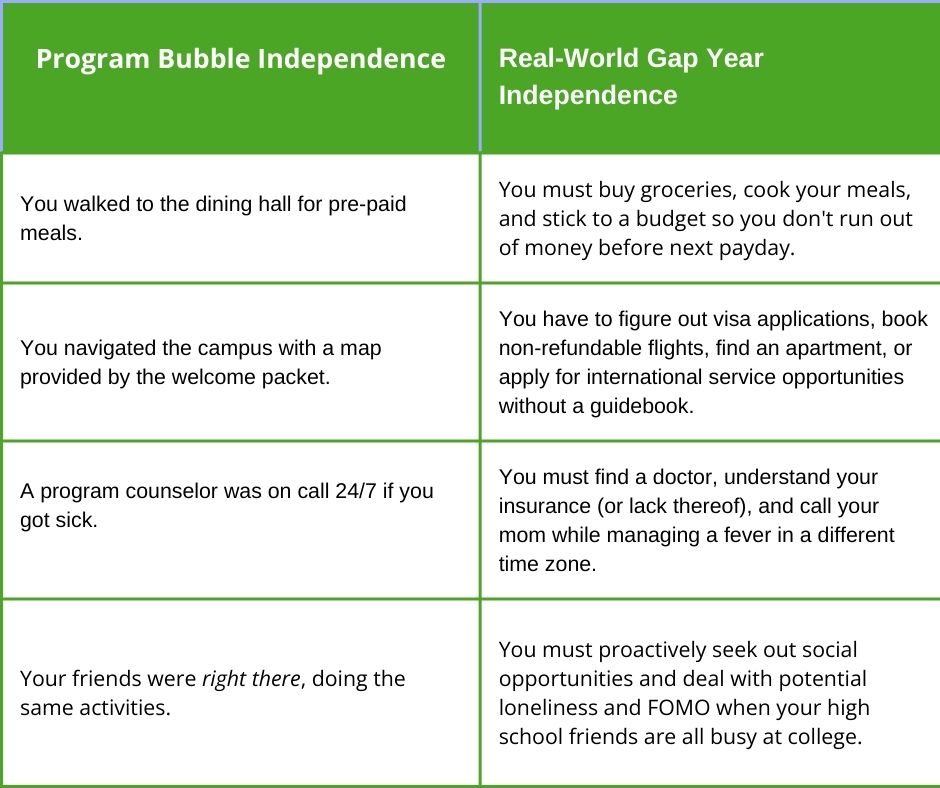
If you feel capable and energized by the thought of tackling real logistics like rent, money, insurance, etc., you’re probably ready for the self-sufficiency of a gap year. If the idea of those non-curated, boring logistical parts makes you want to hide, a gap year might be too much, too soon (and that’s totally okay!).
Was I motivated and engaged every day, or only in certain activities?
Compare what really energized you and what felt like a chore. We’re examining your intrinsic motivation in this question.
- If you loved the classes but found the independent travel or social time stressful, college is a safer bet. You’re intrinsically motivated by a structured academic environment.
- If you hated the 9-to-5 lecture schedule but loved a hands-on project, the freedom after work, and solving problems in the field, a gap year is your power move. You’re intrinsically motivated by doing, experiencing, and building.
Design your gap year around the activities that get you pumped and don’t feel like a chore. For example, if you hated your internship’s coursework but loved its hands-on elements, consider an intensive apprenticeship or a year-long job, which could be a better fit than a full college course load.
Part III: The practicalities (a reality check)
A gap year isn’t a 12-month vacation but a self-directed curriculum that you design and manage. You’re trading academic tuition for the tuition of life experience. And this option requires serious planning.
Am I curious and motivated enough to create my own learning experiences for a year?
No one will hand you a syllabus. The structure is gone. It’s time to separate the dreamers from the doers.
- Structured vs. self-designed: If you’re self-motivated and know you can structure your own time, a self-designed year of working and traveling might be perfect. If you need accountability and clear goals, you should strongly consider a formal gap year program. These programs provide mentors, a schedule, and a cohort of peers, bridging the gap between a summer program and complete independence.
- The discipline test: Your parents won’t be waking you up. Your boss isn’t chasing you for every detail. Will you start the day at a decent hour? Will you show up on time for your volunteer shifts? Will you save that money instead of blowing it on a massive shopping spree? Your level of self-discipline is the greatest predictor of a successful gap year.
Can I handle the logistical and financial aspects of a full gap year?
Deciding to take a gap year is the easiest step. Paying for it and planning the details is the hard part — and your responsibility.
- The “Who’s paying?” question: If your immediate answer is “My parents,” you need to rethink your independence level. Even if your parents are generously offering to pay for a program, get involved in the budgeting, application, and planning process. Can you cover your own travel insurance? Can you manage a spending budget while abroad?
- If your plan involves working, you need a detailed budget: rent, food, transportation, savings, and an emergency fund. You need to know your hourly wage and how many hours you must work each week to meet your goals.
- If your plan involves a program, you need to investigate scholarships and payment plans.
- The living situation: Where will you live for the year? Staying at home saves money, but are you prepared to live by your parents’ rules while all your friends are in dorms? If you plan to travel or volunteer, how will you secure housing (hostels, host families, apartment shares, etc.)? Logistics are tedious, but they’re the backbone of your year.
Do I have a support network to help me plan and navigate a gap year?
Even the most independent person benefits from support. You’re embarking on an emotional journey of self-discovery that can quickly become messy, lonely, and confusing.
- Family buy-in: You must talk to your parents (or guardians). Lay out your plan: the budget, your goals, the logistics. Learn their expectations (weekly check-ins, contributing to household expenses, etc.) and what support they’ll provide (financial, moral, or both).
- The social circle shift: Your social life will change. Your high school friends will be living in a bubble of their own, making new friends, and having new experiences at college. Will you feel left behind or lonely? How will you proactively make new friends? Consider joining local groups, taking a class, or finding a job with people your age. A successful gap year requires resilience against FOMO.
Part IV: The college complications
Consider this section as the most practical part. If you’ve been accepted to a four-year school and choose to take a gap year, you must protect that acceptance.
Deferral vs. applying later
You generally have two options regarding your college application timeline.
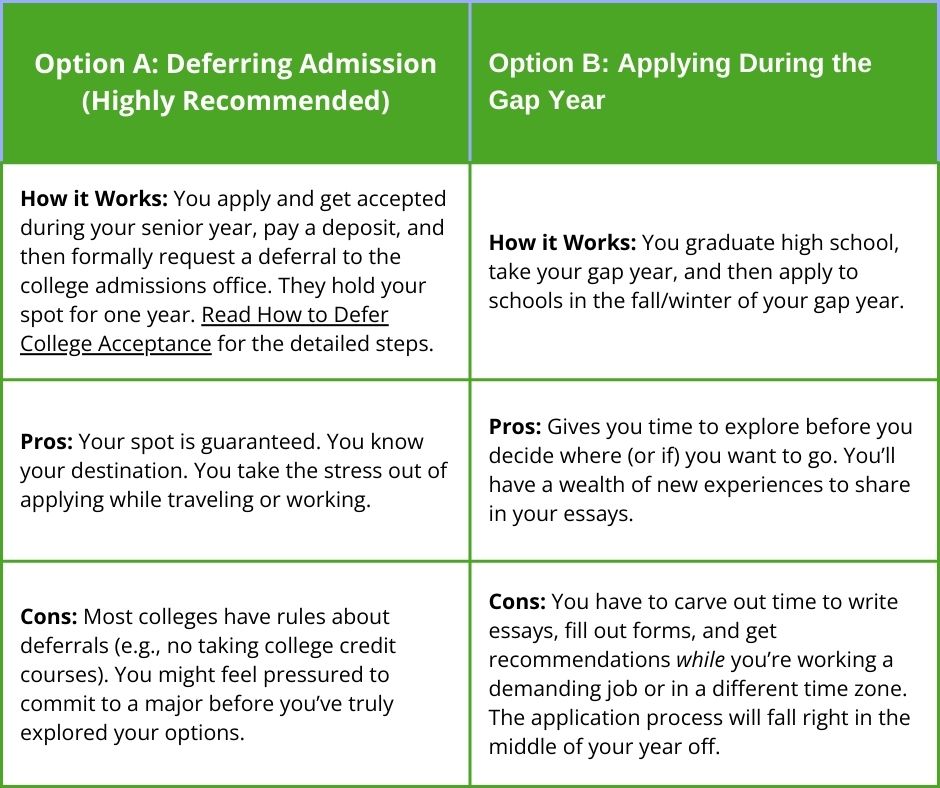
The scholarship and financial aid trap
- Merit and need-based aid: Read the fine print. Many scholarships and grants are intended for students who begin college immediately after high school graduation. If you defer, you could lose eligibility, or the scholarship might not roll over to the next year. Call the financial aid office at the college you’re considering and ask specifically about its policy on deferred merit aid. Don’t assume anything!
- The FAFSA/CSS profile: If you defer, your financial aid package for your future freshman year will often be based on the financial information you submitted during your application year. If you apply during a gap year, you’ll be using your current financial information, which — depending on your situation — could be better or worse for the aid package you receive.
Alternative paths: What if I don’t go to a four-year school at all?
Your summer program may have shown you that a traditional path isn’t the right one for you. A gap year can become a springboard into something else entirely. Maybe an intensive trade certification, apprenticeship, or focused associate’s degree appeals more. You’re not a failure if you don’t follow the crowd. There are many alternatives to a traditional college path — after all, success isn’t one-size-fits-all!
Part V: The final verdict & action plan
So, is a summer program enough to decide on a full gap year?
No. But it’s an excellent indicator of what excites and challenges you. You can’t commit to a 2,000-mile road trip just because you loved the three-block drive to the ice cream shop. You need a detailed map, gas money, and a spare tire.
Here’s your clear, actionable three-step plan for moving forward.
Step 1: Document your data. Create a simple spreadsheet and answer these questions specifically. Don’t generalize.
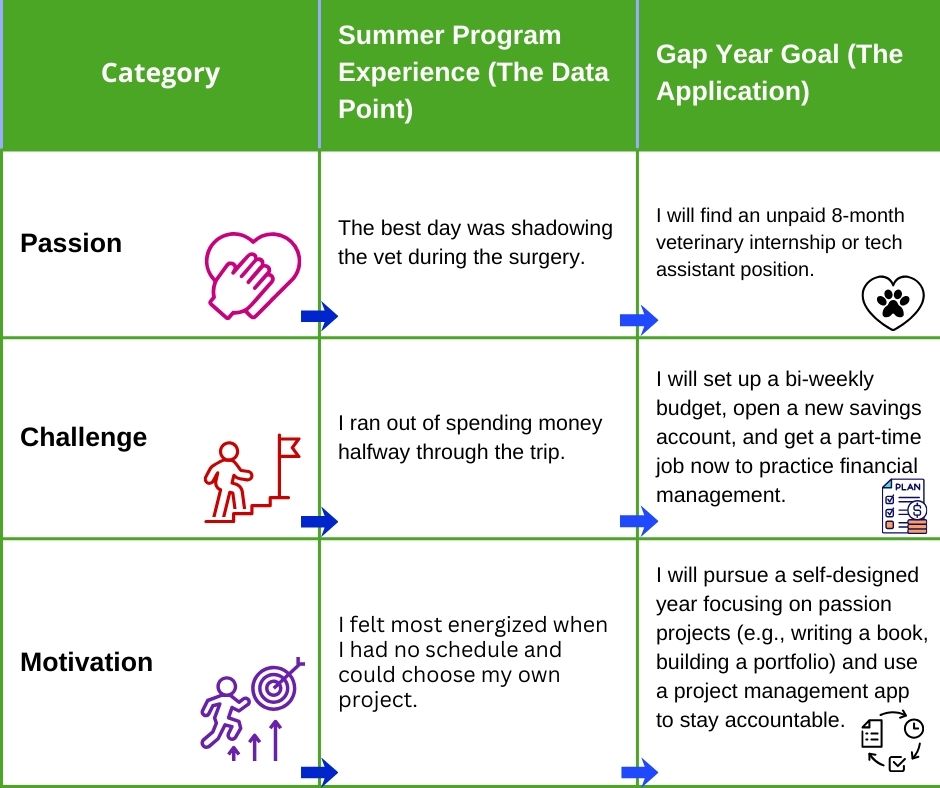
Step 2: Create a Plan B (the college contract). If you haven’t applied to college yet, create a list of schools you would attend, and start the application process. If you’ve been accepted, defer your acceptance if possible to give yourself a safe landing spot. Don’t leave your college future to chance.
Step 3: Get planning, today. A successful gap year isn’t defined by “taking a break” and wandering aimlessly but by what you do with that time.
- Find your focus: Is it career exploration? Language acquisition? Financial savings? Pick one primary goal.
- Research programs/jobs: Start applying for gap year programs, internships, or jobs now. The best opportunities typically have long application windows. Check out the resources in our Gap Year Guide to start narrowing down your options.
- Start the grind: If your gap year requires money, get a job now to prove you have the discipline and start funding your adventure. If it requires language skills, enroll in a community college language class or use an app like Duolingo or Rosetta Stone to practice every day.
The summer program gave you the vision. Now it’s time to put in the work to make that vision a reality. Go for it. You’ve got this!

Blog Categories
- Career Advice
- College Admissions
- Colleges & Universities
- Financial Aid and Scholarships
- For Counselors
- For Parents
- For Students
- Gap Years
- Mental Health and Wellness
- Online Learning
- Performing and Visual Arts
- STEM Majors and More
- Summer Programs
- Teen Volunteering
- Trade & Vocational Schools
- Tutoring & Test Prep








Organization with listings on TeenLife? Login here
Register for Free
We’re here to help you find your best-fit teen-centered academic and enrichment opportunities.
Forgot Password
"*" indicates required fields